10 Critical Post-Migration Pain Points in SAP S/4HANA: A Practical Resolution Guide
Over 18,000 organizations have completed their S/4HANA journey by 2026. Most hit the same wall after go-live and most of the problems were entirely preventable.

SAP S/4HANA migrations frequently encounter predictable post-go-live challenges across performance, user experience, integration, and data quality. Organizations typically experience a 40–60% productivity decline in the first 3–6 months, but with systematic resolution, operational stability is achievable within 8–12 weeks.
This article covers the ten most prevalent post-migration pain points and provides proven resolution strategies drawn from real-world implementations across diverse industries.
Post-migration pain points typically stem from three causes: inadequate testing of real-world scenarios, insufficient user preparation for the Fiori interface, and underestimation of Universal Journal performance demands under production load. The Clean Core concept delivers long-term value but creates immediate friction as teams adapt to standardized processes that diverge from legacy customizations.

1. Universal Journal Performance Issues

The Universal Journal (ACDOCA) consolidates all financial transactions into a single table, replacing BSEG, FAGLFLEXA, COEP, and others. Complex financial reports that previously ran in 2–3 minutes can take 15–20 minutes under peak month-end loads, creating bottlenecks that cascade through dependent processes.
The root cause is the Insufficient HANA memory for the expanded dataset, missing indexes for organisation-specific query patterns, and legacy custom reports not re-optimised for the new table structure.
2. Fiori App Adoption Resistance

Productivity typically drops 50–70% in the first month as users adapt to role-based launchpads, tile navigation, and Fiori's responsive design. Power users who've built muscle memory around specific transaction sequences feel the resistance most acutely.
Phase 1 (Top 10 Transactions): Intensive training on the most-used processes (invoice processing, expense reporting, budget monitoring) with personalized launchpad configurations.
Phase 2 (Advanced Features): Introduce workflow approvals and analytics dashboards once Phase 1 comfort is established.
Phase 3 (Specialized Functions): Expand to asset management, project accounting, and domain-specific capabilities.
3. Custom Code Compatibility Issues

Custom programs that accessed tables like BSEG or COEP directly fail in S/4HANA because those tables no longer hold current data. Organizations typically find 20–40% of their custom code requires modification or full rewriting; a scope that consistently surprises project teams who relied on pre-migration tooling alone.
Code Analysis: Run the Custom Code Migration app (/SDF/CD_ANALYSIS) to identify all affected programs. Prioritize by business criticality and usage frequency.
Remediation: Replace direct table access with CDS views and standard APIs. Programs hitting BSEG should use Universal Journal compatibility views or be rewritten against ACDOCA directly.
Testing: Validate modified code against production data volumes in parallel environments. Implement automated regression testing for critical programs.
4. Reporting and Analytics Gap

Traditional tools (Report Writer, Report Painter, ABAP Query) may not deliver equivalent functionality in S/4HANA. Critical management reports or regulatory submissions can break entirely, with the impact becoming severe when external auditors require specific formats that no longer work.
Strategic approach: Categorize reports into three tiers. Tier 1 (regulatory/critical) gets immediate CDS view replacements. Tier 2 (management reporting) migrates to SAP Analytics Cloud. Tier 3 (operational) transitions to standard Fiori analytical apps.
5. Integration Complexity with Third-Party Systems

S/4HANA's API-first architecture and updated data models create compatibility issues with existing third-party integrations. Legacy interfaces using IDocs, RFCs, or file exchanges may fail due to changed data structures or enhanced validations. When CRM, e-commerce, or supply chain tools lose sync with S/4HANA, the cascading impact reaches customer service, inventory, and financial reporting simultaneously.
Resolution Approach: Implement a hub-based integration architecture using SAP Integration Suite to provide standardized API management, data transformation, and error handling, replacing fragile point-to-point connections with a monitored, scalable layer.
6. Master Data Migration Inconsistencies
Master data inconsistencies surface only during live operations. Incomplete vendor bank details block payment runs. Customer credit limits that didn't transfer correctly halt sales orders. Missing material master attributes disrupt procurement and production planning. S/4HANA's enhanced validations expose quality problems that legacy systems quietly tolerated.
Data Quality Assessment: Use MD04 and VD03 reports to identify gaps systematically. Automated validation scripts against S/4HANA requirements accelerate triage.
Cleansing: Establish data stewardship with clear domain ownership. Use MASS or custom programs for efficient mass corrections with full audit trails.
Ongoing Governance: Deploy SAP Master Data Governance with data quality scorecards and preventive controls at point of entry.
7. Authorization and Security Model Complexity
S/4HANA's authorisation model introduces Fiori-specific roles, embedded analytics permissions, and Universal Journal access controls that don't map directly from traditional SAP concepts. Existing roles often require complete redesign rather than migration. Compliance auditors then require demonstration of proper access controls across the integrated FI/CO environment, a new challenge for most teams.
Resolution Strategy: Use SAP's recommended RBAC methodology for S/4HANA: define business roles before technical roles, then leverage SAP Identity Management or Cloud Identity Access Governance for automated provisioning and access certification.
8. Period-End Closing Process Disruptions
Traditional closing sequences that relied on batch processing and summary table updates don't translate cleanly to S/4HANA's real-time architecture. New validation rules also identify previously undetected inconsistencies that prevent successful period closure, often discovered for the first time at month-end under pressure.
Key actions: Redesign closing procedures for real-time processing. Implement parallel execution for time-intensive activities, automate routine tasks via job scheduling, and deploy closing monitoring dashboards with live status visibility.
9. Mobile and Remote Access Limitations
Fiori apps don't always provide full mobile functionality for field-based processes requiring offline capability or complex data entry. Remote access can suffer when apps demand high bandwidth, and mobile compatibility issues can lock out users from essential functions during travel or site work.
PWA Implementation: Enable progressive web application capabilities for critical Fiori apps to provide offline functionality and local data caching.
SAP Mobile Start: Deploy as a unified mobile entry point with single sign-on and push notifications.
MDM Policy: Establish mobile device management policies that maintain security while enabling productivity across device types.
10. Training and Knowledge Transfer Gaps

Traditional transaction-based training doesn't address the role-based, process-oriented nature of Fiori. Knowledge gaps compound when power users must support operations while learning new capabilities themselves, creating a support burden at exactly the wrong moment.
Role-Based Curricula: Build training around completing business processes, not navigating menus. Use hands-on environments with realistic scenarios mirroring production.
Continuous Learning: Implement SAP Enable Now or equivalent for just-in-time support accessible in the flow of work.
Internal Expert Network: Pair experienced S/4HANA users with learners for contextual peer mentorship, the most cost-effective adoption accelerator available.
Comprehensive Resolution Framework
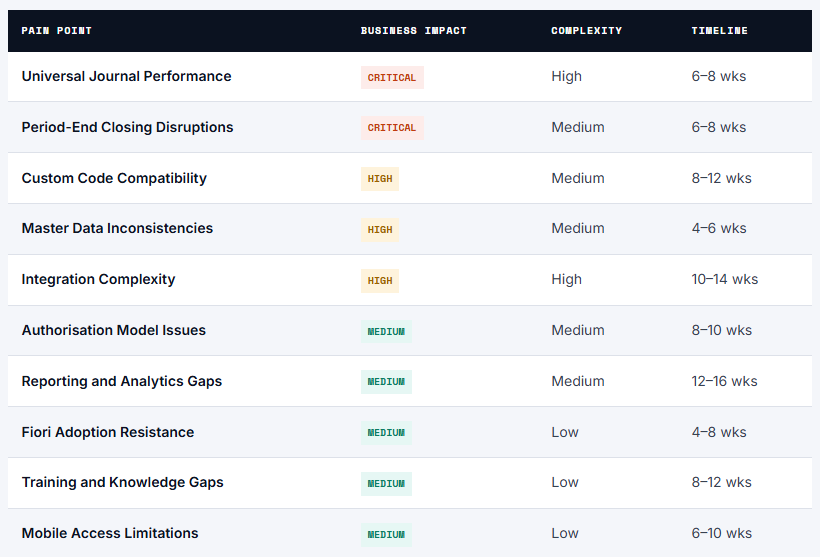
The priority matrix below reflects both business impact and resolution complexity. Critical items are those where disruption carries immediate regulatory, financial, or operational consequences, these anchor Phase 1 regardless of other sequencing considerations.
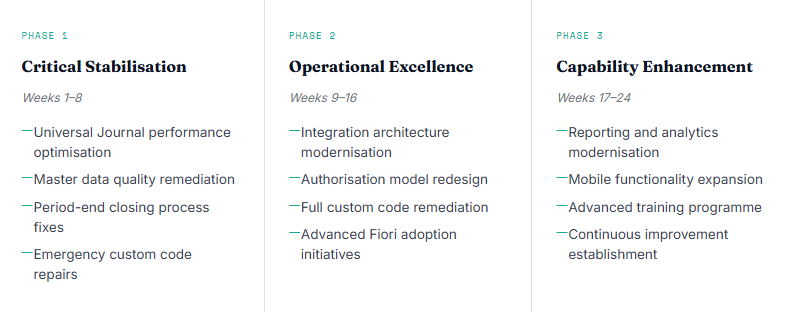
Resolution is structured across three sequential phases, restoring business continuity before shifting focus to operational excellence:
ROI Expectations
Organizations implementing comprehensive post-migration resolution frameworks typically achieve the following benchmarks within 12 weeks:

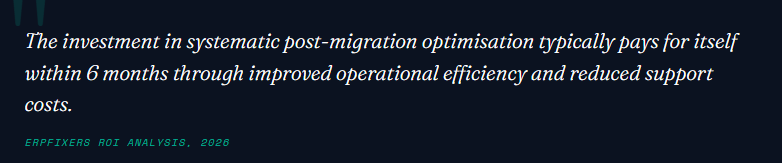
Full ROI realization typically occurs within 8–12 months, with immediate gains from stability and productivity, and strategic value emerging as organizations leverage S/4HANA's enhanced capabilities for process optimization and innovation.