

Cloud & S/4HANA Migration Pressure for Finance Leaders
Why staying on legacy ERP is becoming a strategic risk — not a safe choice
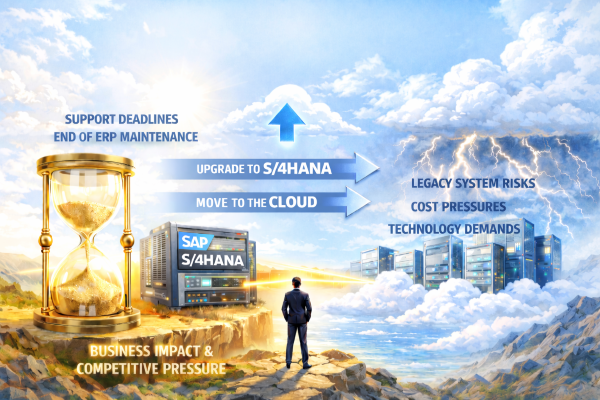
Key Takeaways
The shift from IT-driven roadmaps to business-driven priorities has transformed Cloud and S/4HANA migration into a strategic imperative. Organizations are no longer evaluating migration as a purely technical project; the drivers now include business agility, cost efficiency, compliance with regulatory requirements, the need for data-driven decision-making, and alignment with SAP’s innovation roadmap. For finance functions, this change reframes the discussion from debating whether to migrate to focusing on how quickly modernization can be achieved without disrupting core operations. Migration is increasingly about enabling finance teams to operate with speed, intelligence, and resilience, while leveraging real-time insights and scalable digital processes.
What may feel like cost avoidance today — postponing your S/4HANA journey — often becomes crisis-driven migration tomorrow, executed under time pressure, at significantly higher expense, and with greater operational disruption. Proactive migration, by contrast, allows organizations to simplify their data models, embed intelligent automation, enhance reporting, strengthen compliance, and scale operations in the cloud — all while protecting long-term competitiveness.
Companies that act proactively position themselves to reap significant competitive advantages, including faster financial reporting, improved operational efficiency, and the ability to adapt rapidly to changing market conditions. Conversely, organizations that delay modernization face mounting risks: they will eventually be forced to migrate under more constrained timelines, with fewer options, higher costs, and greater disruption to business operations. In essence, the pace and strategy of S/4HANA migration have become a defining factor in finance-led business transformation, determining which organizations will thrive in an increasingly dynamic, data-driven environment.
Find out why successful organizations are reframing S/4HANA migration as a finance-led transformation rather than a technical upgrade.
Fill the form below and instantly download the full article.
