

Before You Trust AI with Your Margins, Fix Your Cost Data
Why Cost Stratification has to come before AI in SAP Finance

Finance teams are racing to put AI copilots on top of SAP. Most are pointing them at numbers that were never granular enough to answer the question in the first place.
Every finance leader has the same slide in their 2026 deck: an AI copilot sitting on top of SAP, answering questions in plain language, closing the books faster, flagging anomalies before they become quarter end surprises. The investment is real. According to Deloitte's most recent CFO Signals survey, 93% of organizations now use AI extensively or modestly across multiple functions, up from just 66% experimenting three years ago. Within finance specifically, 44% are already applying it to planning and budgeting, and 41% to financial data analysis.
Then the same survey asks CFOs what worries them most about that AI, and the answer is not hallucination or job displacement. It is something closer to home.

The blind spot AI cannot see around
In most SAP environments, cost detail is rich right up until the moment it matters most. A standard cost estimate can carry up to 120 individual cost components, rolled up into three familiar buckets: material, labor, and overhead, with freight and subcontracting layered on top depending on how a company has configured its cost component structure. The itemization view shows every resource and cost element behind a finished good. The cost component view aggregates those into the categories a controller actually reads.
That detail survives the plan. It mostly survives the production or process order, where actual costs settle against the estimate. Then goods are sold, and the structure collapses. What lands in the general ledger, and in every downstream report built on top of it, is a single blended COGS figure. A labor cost increase, a freight surcharge, and a scrap run all net out into one number that moved.

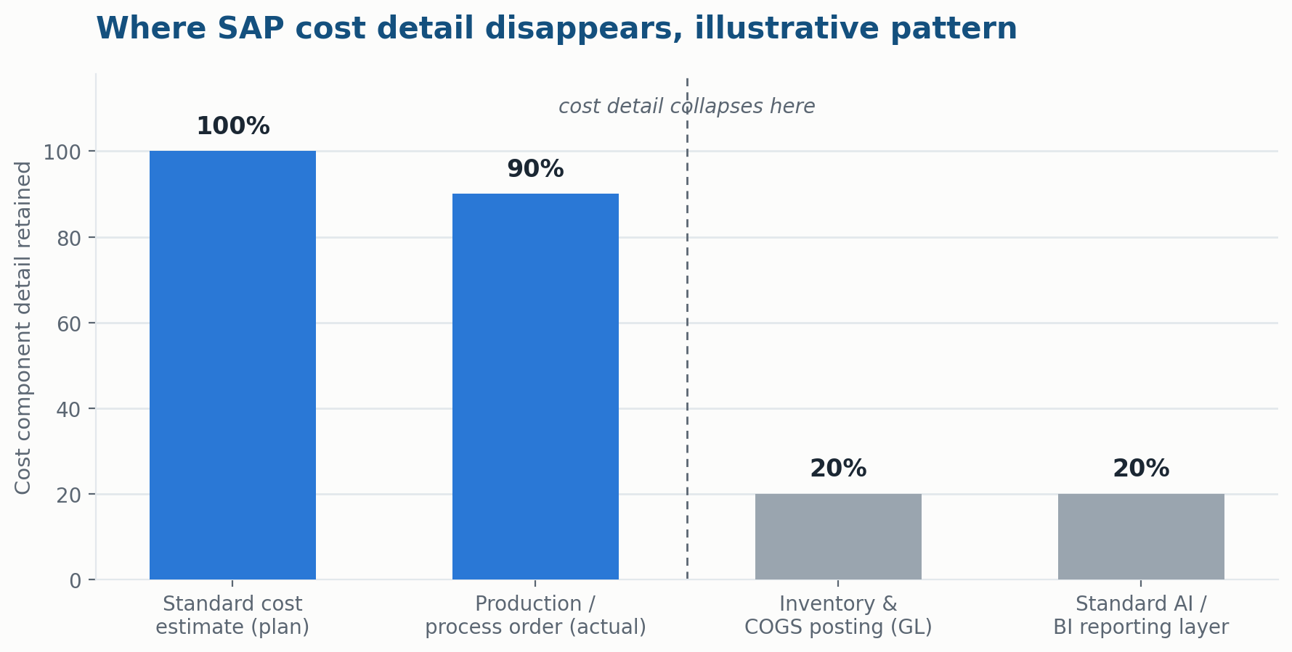
The detail does not erode gradually. It falls off a cliff at the exact point controllers, and any AI reading their reports, need it most.
An AI copilot asked "why did margin drop in the Southeast region last month" is reading from that same ledger. It does not have access to a cost breakdown that was never preserved past the production stage. So it does one of two things: it gives a plausible sounding answer built on incomplete data, or it tells you it cannot tell, which is the honest answer but not the one anyone wanted from a tool sold on speed.
An algorithm can summarize a number instantly. It cannot decompose a number that was never broken apart to begin with.
A margin drop, decoded
Consider a scenario that plays out constantly across SAP manufacturing and distribution environments. A controller pulls the monthly profitability report and finds gross margin down 3.1 points against last quarter. The blended COGS view shows exactly one fact: cost of goods sold rose 8.0% as a share of revenue. That is the entire explanation the standard report offers. It does not say which plant, which product line, or which cost driver moved. It is a symptom with the diagnosis stripped out.
Stratified back into its real components, the same 8.0 point increase tells a completely different story.
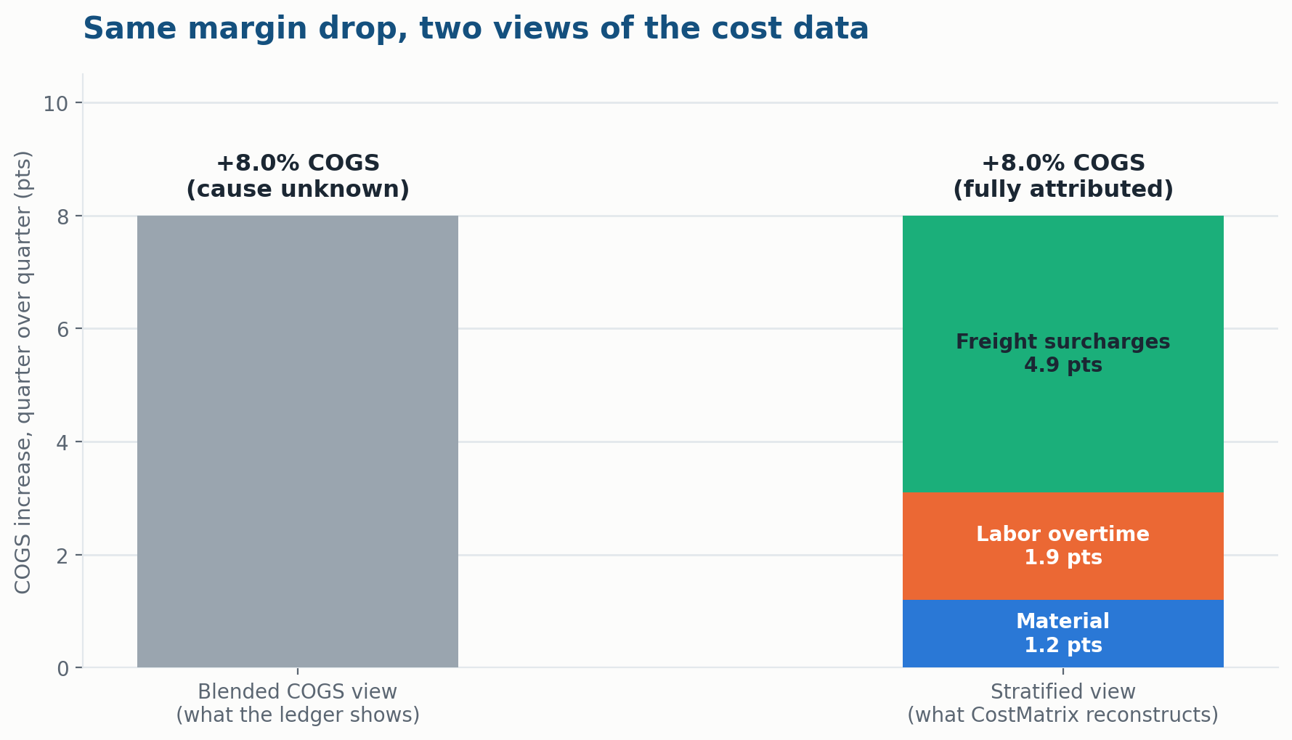
Now the number has an owner. Freight surcharges, 61% of the increase, point procurement toward carrier renegotiation or a nearshoring conversation. Labor overtime, 24%, points operations toward a staffing or scheduling fix at the plant that is running hot. Material cost, the remaining 15%, is small enough this quarter that a commodity hedge can wait. Three different teams, three different actions, one number, and none of it is visible from the blended figure alone.
This is the difference stratification makes in practice. Not a prettier report. A report that can actually be acted on, by a person or by an AI agent asked to summarize it.
AI does not fix bad data. It amplifies it
The industry data on AI project outcomes backs this up in a way that should worry anyone about to point a copilot at unstratified cost data. RAND Corporation's analysis of 65 documented enterprise AI initiatives found that 80.3% failed to deliver their promised business value, split roughly three ways: about a third abandoned before ever reaching production, another third that reached production but did not deliver expected value, and the remainder that ran but never recouped their cost.
Gartner's infrastructure research points at the same failure mode from a different angle, forecasting that by the end of 2026, 60% of AI projects will be cancelled outright because of inadequate data foundations. The pattern Gartner describes is specific: master data that was never cleaned up, and no clear ownership for maintaining it. That is a precise description of what happens to SAP cost data between the plan and the posting.
In finance, this failure mode does not look like a crashed model or an error message. It looks like a confident, well formatted answer that is quietly wrong, because the AI was never shown the freight surcharge, the overtime spike, or the material variance behind the number it summarized. A wrong answer that reads as authoritative is more dangerous to a controller than no answer at all.
What SAP's own AI tools are, and are not, built to do
SAP's Joule and the broader Business AI roadmap are genuinely useful for what they target: accelerating the close, drafting responses in accounts payable and receivable, surfacing anomalies in transactional workflows. Vendors are consistent on one point when describing what makes these tools work: they need "a consistent minimum: stable workflows, clear responsibilities, and usable master data." That is a fair bar for automating a process.
Margin and cost analysis is a different kind of problem. It is not about whether a workflow is stable. It is about whether the underlying cost data still has its component parts by the time someone, human or AI, goes looking for them. Today, in most SAP ECC and S/4HANA environments, it does not, and no amount of workflow automation on the AP or close side changes that.
Cost stratification: the layer AI needs underneath it
This is the layer that has to exist underneath any AI investment in finance: cost data broken back down into its real drivers, by material, plant, profit center, and customer, so a variance has a cause and not just a size. That is the specific gap CostMatrix™, ERPfixers' Cost Stratification and Transparency Engine, was built to close inside SAP. It reconstructs the labor, material, freight, and overhead detail that standard postings collapse, so controllers, and any AI layered on top of their reporting, are working from numbers that can actually explain themselves.
Think of it as sequencing, not competition. An AI copilot is only as useful as the granularity of what it is reading. Teams that stratify their cost data first get AI tools that can answer the "why" behind a margin move. Teams that skip that step get a faster, more confident sounding version of the same blind spot, and, per the data above, a real chance the AI initiative gets cancelled once leadership notices the answers do not hold up.
Variance analysis that holds up. Trace a margin swing to labor, material, or freight instead of a single blended delta.
AI ready inputs. Give any copilot or agent cost data granular enough to generate a real explanation, not a guess.
Multi-dimensional drilldown. Slice cost by material, plant, profit center, and customer without a manual reconciliation project.
No rip and replace. Works against existing SAP ECC and S/4HANA data, including Material Ledger and actual costing configurations already in place.
A typical six-week rollout for midmarket and enterprise manufacturing and distribution teams, delivered remotely or hybrid.
The CFOs telling Deloitte they are worried about cost transparency are not wrong to be cautious about AI. They are describing a gap that existed long before any copilot showed up, and one that is quietly deciding whether their AI investment lands in the 20% that delivers value or the 80% that does not. Closing it first is what makes every AI initiative after it worth trusting.
Know what your AI is reading before you scale it
ERPfixers built CostMatrix™ to give SAP finance teams cost data with its detail intact, the foundation any AI or human analysis actually needs. Talk to us about what a stratified cost model would surface in your environment.