

Parallel Valuation in S/4HANA: Legal, Group, and Profit Center Views Explained

When a plant in Germany ships finished goods to a sister company in the United States, that single movement has three honest answers to the question "what is this inventory worth?" The tax authority wants the arm's length transfer price. The group CFO wants the true production cost, with internal markup stripped out. The division heads want the internal price they negotiated with each other. SAP S/4HANA can record all three at once, in the same journal entry, through a capability called parallel valuation.
This article explains the three valuation views (legal, group, and profit center), how S/4HANA stores them through the Actual costing and the Universal Journal, what changed with Universal Parallel Accounting, and what finance leaders should decide before switching any of it on.
What Parallel Valuation Actually Means

Parallel valuation is the ability to value the same goods and services by more than one method at the same time. A company might carry its inventory at 100,000 dollars for legal reporting and 90,000 dollars for group reporting, because the legal figure includes margin earned by a sister company
S/4HANA combines two dimensions to do this: the currency (local, group, hard, index based, global company) and the valuation view (legal, group, profit center). Each combination is a currency type with its own two-digit code, and each journal entry can carry several of them side by side.
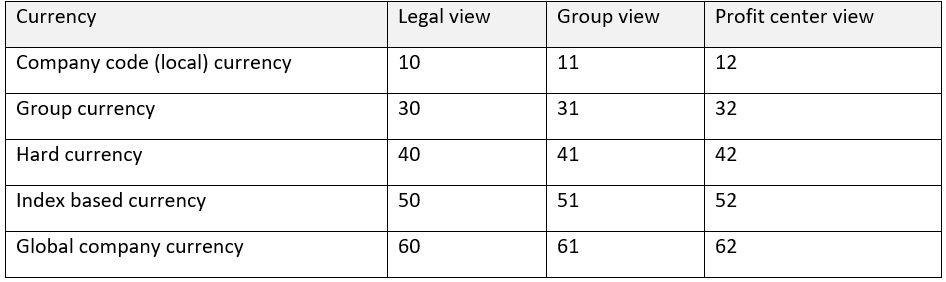
The pattern is easy to remember: the first digit names the currency, the second names the view (0 legal, 1 group, 2 profit center). Which combinations a company uses is set in the currency and valuation profile (transaction 8KEM), which is assigned to the controlling area (transaction 8KEQ).
The Legal View: What Each Entity Reports

The legal view is the statutory truth for each company code. Every legal entity records its inventory separately from every other entity, even inside the same group, and it values that inventory under the accounting standard of its country.
When one group company sells to another, the legal view books the sale at the intercompany transfer price. That price must meet the arm's length standard tax authorities expect, so the selling entity shows a profit, and the buying entity carries inventory at the price it paid.
The legal view is not optional. It feeds the statutory financial statements, tax returns, and local audits, and it is what currency types 10 and 30 hold in the leading ledger.
The Group View: The Company as One Business

The group view treats every company in the group as a single business. Goods and services exchanged between affiliates are valued without any intercompany profit, so cost of goods manufactured reflects what the group actually spent.
This gives an "at cost" picture of every intercompany transaction alongside the legal markup. For physical goods, S/4HANA creates extra journal entries that move intercompany revenue and cost of goods sold to a group valuation clearing account, removing their effect from the group figures.
The payoff is a group margin by product, customer, and region that is already free of internal profit, rather than one reconstructed by consolidation adjustments at period end. Transfer pricing uses currency types 11 and 31, and SAP requires both to be maintained in the currency settings before it can be activated.
The Profit Center View: Divisions as Businesses

The profit center view works in the opposite direction to the group view. Transfer pricing treats several companies as one; profit center valuation can treat one company as several businesses.
It values goods passed between profit centers at internal transfer prices that management agrees, for example between divisions. A plant-to-plant transfer inside one company code then behaves like a sale and a purchase, so each division shows its own revenue, cost, and margin.
This view suits organizations whose profit centers represent divisions that are measured on profit. It uses currency types 12 and 32, and it needs extra configuration to map transfer prices at profit center level, so SAP PRESS recommends switching it on only where reporting truly needs it.
How S/4HANA Makes It Work

Three building blocks carry parallel valuation in S/4HANA.
Actual Costing: It is now mandatory in S/4HANA and is the sole means of valuing materials, while actual costing remains optional. It tracks every material movement in each currency type and view.
The Universal Journal (table ACDOCA): Actual costing detail is stored in the Universal Journal, so inventory valuation and finance share one source of truth with no reconciliation between them.
Ledgers: Because finance and controlling now share one journal, each currency and valuation view must be assigned to a ledger. There are two ways to do that.
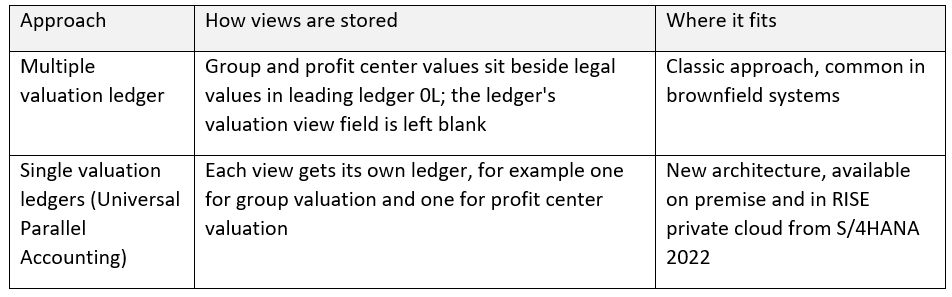
Universal Parallel Accounting extends ledgers beyond the general ledger into asset accounting, controlling, and the Actual costing, and allows up to ten currencies across all ledgers. Transfer pricing arrived with it first, and profit center valuation followed in S/4HANA 2023.
One Shipment, Three Answers: A Worked Example

The figures below are illustrative, in euros per unit. A German manufacturing company produces a unit for 80. Inside that company, the production profit center hands it to the sales profit center at an agreed internal price of 90. The German company then sells it to its US sister company at a transfer price of 100, and the US company sells it to an external customer for 130.
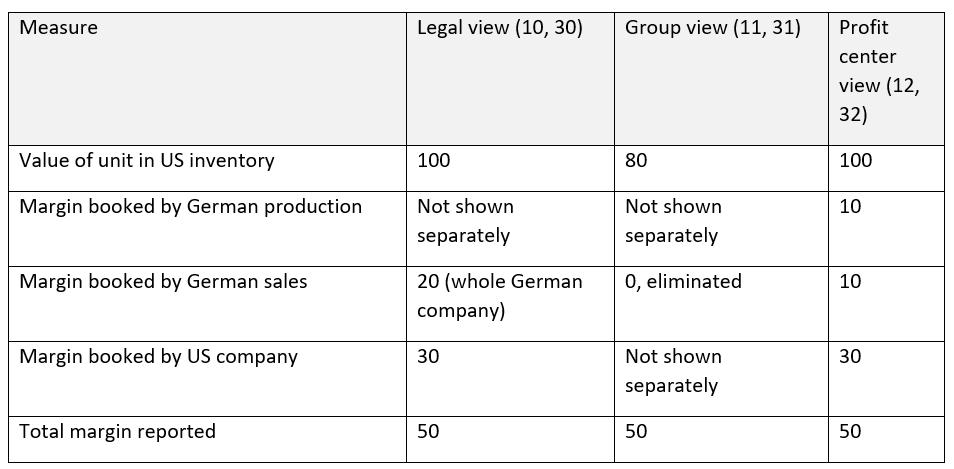
The total profit never changes: the group earns 50 per unit whichever lens you use. What changes is where the profit sits and when it is recognized. In the legal view, 20 of it is recognized in Germany as soon as the unit ships, even though the group has sold nothing yet. In the group view, the full 50 appears only when the external customer buys. In the profit center view, each division can see the share it earned.
If the unit is still sitting in the US warehouse at month end, the gap between the legal value (100) and the group value (80) is exactly the unrealized intercompany profit that consolidation must remove. Group valuation removes it at the moment of posting instead.
What to Decide Before You Switch It On

Parallel valuation is a design decision, not a toggle. These are the questions that shape the project.
1. Which views do you actually need? Legal is always required, and group or profit center valuation cannot be configured on their own without it. Many companies need legal and group but not profit center, and SAP PRESS advises activating only the views required now or planned for the future.
2. Multiple valuation ledger or Universal Parallel Accounting? Single valuation ledgers bring a simpler authorization concept and cleaner separation, but they also mean separate close processing for each valuation view.
3. Greenfield or brownfield? The Universal Parallel Accounting business function (FINS_PARALLEL_ACCOUNTING_BF) is activated at system level, cannot be reversed, and expects no postings, no asset data, and no material prices in the system. Existing systems need a migration project under FINS_UPA_MIGRATION, which requires SAP's approval through a support case.
4. Is your transfer pricing master data ready? Profit center valuation in particular depends on internal prices being defined and maintained, and every price feeds every downstream margin.
5. Does your close calendar allow for it? Actual costing runs, group valuation clearing, and differences between currency types 30 and 31 at goods receipt all need owners. SAP has a dedicated note for that last case.
Once live, the payoff is visible in SAP Fiori. The Journal Entry Analyzer and Material Value Chain Analysis apps let users compare legal, group, and profit center results side by side and trace a material's cost through every company code and profit center.
Three Views, One Version of the Truth

Parallel valuation lets one S/4HANA system answer three different questions without spreadsheets or after the fact adjustments: what each entity owes the tax authority, what the group truly earned, and how each division performed. The Actual costing and the Universal Journal make that possible; the design choices around views, ledgers, and transfer prices decide whether it actually pays off.
How ERPfixers can help
ERPfixers helps SAP finance and controlling teams turn parallel valuation from a configuration setting into reliable numbers leaders can trust. Our fixers start with an assessment of your reporting needs to decide which views you truly require, then design the currency and valuation profile, ledger strategy, and Actual costing setup to match, whether that means a multiple valuation ledger or Universal Parallel Accounting.
We define and load transfer prices for intercompany and profit center flows, configure actual costing and group valuation clearing, and build Fiori reporting so legal, group, and profit center results can be compared side by side. For companies already live on S/4HANA, we diagnose valuation differences, fix inconsistent postings between currency types, and plan the readiness checks and migration path for Universal Parallel Accounting.
If your group margin still depends on manual eliminations or spreadsheet adjustments, talk to ERPfixers about building parallel valuation that works from the first posting to the final close.
📺Subscribe to our YouTube Channel
📧Send us an email info@erpfixers.com
📱Call us at +1 (302) 551-3627
📅Set an appointment today CALENDAR