

SAP Bluefield Migration: Balancing Risk and Agility in the Journey to SAP S/4HANA
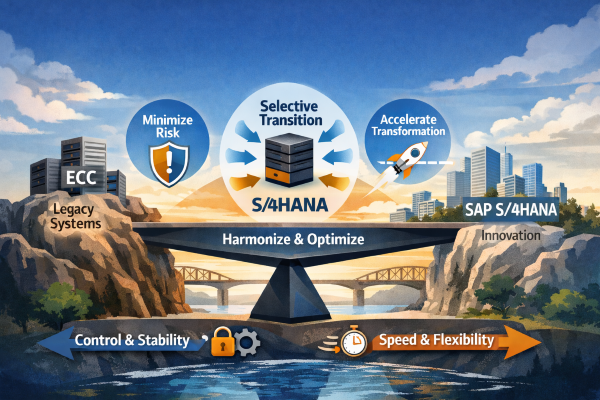
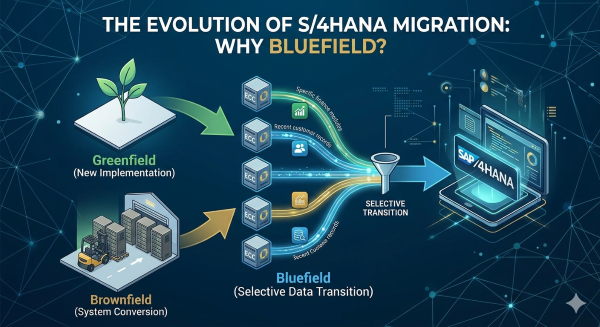
For organizations operating legacy ERP landscapes, the move to SAP S/4HANA is far more than a technical upgrade. It is a strategic transformation of the enterprise core. Yet, the path to modernization is not always straightforward. While Greenfield promises innovation through reinvention and Brownfield ensures continuity through system conversion, many enterprises find themselves needing a more balanced approach. This is where SAP Bluefield migration emerges as a compelling alternative.
SAP Bluefield is a hybrid migration strategy designed to combine stability with flexibility. It enables organizations to selectively transition data, processes, and configurations, preserving what works, eliminating inefficiencies, and modernizing critical business capabilities. Rather than forcing a complete rebuild or carrying forward legacy complexity, Bluefield provides a structured pathway to transformation with reduced disruption.
A Strategic Imperative: Why Bluefield, Why Now?
From an executive perspective, SAP transformation is increasingly measured by speed-to-value, operational continuity, and return on investment. CIOs are tasked with minimizing downtime, CFOs demand predictable costs, and business leaders expect rapid innovation without compromising stability.
SAP Bluefield addresses these priorities by enabling a controlled and selective migration approach. Unlike traditional models, it allows enterprises to move forward with intention, transitioning only what aligns with business value.
This strategic selectivity empowers organizations to:
Preserve key competitive differentiators embedded in existing processes
Eliminate technical debt accumulated over years of customization
Modernize incrementally while maintaining business continuity
For enterprises operating in regulated industries or managing complex integrations, this balance between transformation and stability is not just beneficial—it is essential.
Understanding the Migration Landscape
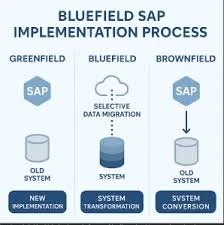
Selecting the right migration strategy requires a clear understanding of the available options:
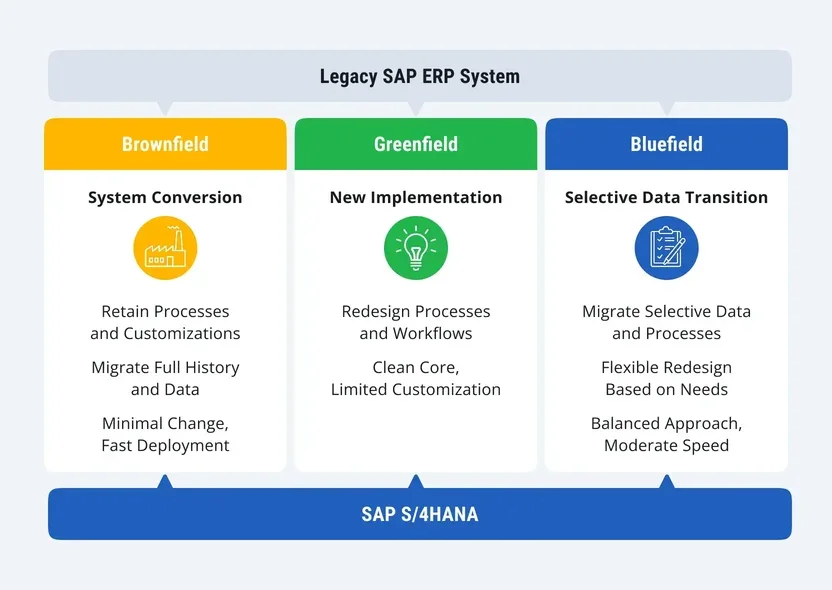
Brownfield Migration
A system conversion approach that upgrades the existing SAP environment while retaining configurations and custom code. It offers speed and lower disruption but may perpetuate legacy inefficiencies.
Greenfield Migration
A complete reimplementation of SAP from the ground up. This approach enables full process redesign and innovation but demands significant time, cost, and organizational change.
Bluefield Migration
A selective data transition approach that combines elements of both. It allows businesses to modernize targeted areas while preserving stable operations, delivering transformation without unnecessary disruption.
Managing Risk Through Intelligent Design
Every SAP migration introduces inherent risks, data inconsistencies, operational downtime, and change management challenges. Bluefield does not eliminate these risks but redistributes and mitigates them through intelligent design.
Using techniques such as selective data transition, parallel system landscapes, and phased deployments, organizations can:
Validate processes in controlled environments
Migrate business units in stages
Minimize enterprise-wide disruption
This phased approach significantly reduces the “shockwave effect” often associated with large-scale ERP transformations. Critical functions such as finance, supply chain, and procurement can be piloted, refined, and scaled with confidence.
Cost Optimization Beyond Budget Reduction
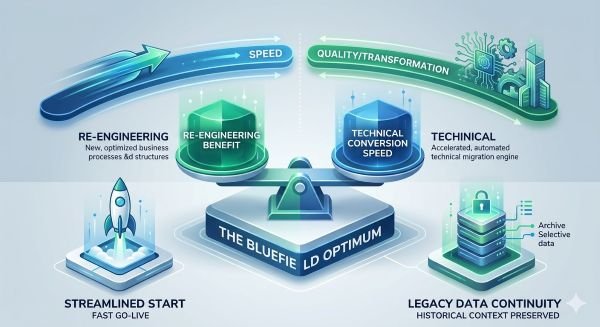
The financial value of Bluefield extends beyond traditional cost comparisons. Its efficiency lies in how transformation is executed:
Reduced rework: Only relevant data and processes are migrated
Accelerated timelines: Parallel execution shortens project duration
Optimized resources: Less reliance on large-scale retraining and redesign
Business continuity: Avoidance of revenue-impacting downtime
Industry insights consistently show that selective migration approaches can significantly accelerate time-to-value compared to full system reimplementation. More importantly, they reduce the hidden costs associated with prolonged transformation cycles and organizational fatigue.
The Role of Selective Data Transition (SDT)
At the core of Bluefield lies Selective Data Transition (SDT), a methodology that enables precise and value-driven data migration.
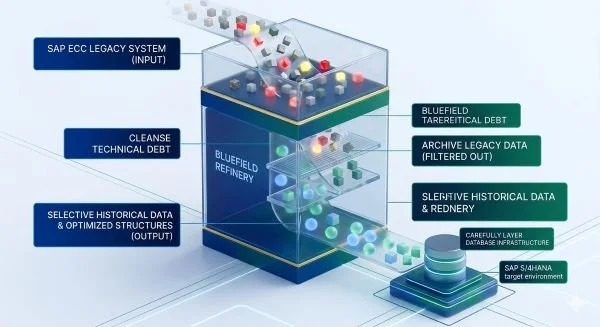
Rather than migrating entire datasets, SDT focuses on relevance and quality:
Retaining high-value, business-critical data
Archiving obsolete or redundant information
Enhancing data quality for improved analytics and performance
For example:
Finance teams may migrate only recent fiscal data while archiving historical records
Sales operations may transition active customers and open transactions while excluding inactive accounts
This targeted approach ensures that the new SAP S/4HANA environment operates on clean, optimized datasets, maximizing performance and analytical capabilities.
Overcoming Implementation Challenges
While Bluefield offers flexibility, it requires disciplined execution. Key challenges include:
Data Mapping and Governance: Ensuring consistency and integrity across systems
Custom Code Rationalization: Evaluating and optimizing legacy enhancements
User Enablement: Preparing teams for new interfaces and processes
Addressing these challenges demands a structured approach, combining technical expertise with strong governance frameworks.
Best Practices for a Successful Bluefield Migration
To fully realize the benefits of Bluefield, organizations should adopt proven implementation practices:
Align migration objectives with business outcomes
Conduct a comprehensive system landscape assessment
Segment migration by business unit, geography, or function
Leverage automation for testing and validation
Establish strong governance and data quality controls
These practices ensure that migration efforts remain aligned with strategic goals while minimizing execution risk.
Enabling Bluefield with Data Intelligence Platforms
Data quality plays a pivotal role in any migration initiative. Companies like ERPfixers provide specialized capabilities to support Bluefield transitions by:
Profiling and cleansing legacy data
Validating data against SAP standards
Automating rule-based corrections
Monitoring data integrity throughout migration phases
Such platforms enhance decision-making around what data to migrate, archive, or discard, ensuring that only high-value information enters the new system.
The Importance of a Trusted Migration Partner
Given the complexity of SAP landscapes, partnering with experienced SAP specialists is critical. A qualified partner brings:
Proven migration accelerators and methodologies
Industry-specific compliance frameworks
Expertise in data validation and transformation
Experience across global and multi-system environments
Beyond execution, the right partner serves as a strategic advisor, helping organizations navigate transformation with confidence.
Conclusion: A Blueprint for Controlled Transformation
SAP Bluefield migration represents a pragmatic and forward-looking approach to ERP transformation. It delivers the agility of modernization without the disruption of full reimplementation, enabling organizations to evolve their digital core with precision and control.
For technology leaders, the objective is no longer just migration, it is sustainable innovation. Bluefield enables this by aligning transformation with business value, reducing risk exposure, and accelerating time-to-impact.
With the right strategy, governance, and supporting tools, SAP Bluefield is not merely a migration path, it is a foundation for long-term digital leadership.
Bluefield offers more than a migration; it’s a chance to align your systems with your future goals. With its selective approach, you gain the flexibility to optimize processes, modernize your operations and make the most of SAP S/4HANA’s advanced capabilities.
ERPfixers stands as your necessary beacon of reliable SAP knowledge, founded specifically to bridge the gap for those seeking quality, skilled, and immediate SAP solutions. We offer the comprehensive scope of a large-scale consultancy with a level of expertise they simply cannot match.
Whether you’re optimizing for growth, restructuring or preparing for the future, ERPfixers’s Bluefield approach ensures your transformation is as seamless and successful as possible.
Let’s explore how we can help you unlock the full potential of SAP S/4HANA with confidence.
Schedule a meeting with one of our SAP experts today to operationalize your data strategy.
📧info@ERPfixers.com
📱+1 (207) 573-0486 x 800
🎯Follow us on LinkedIn
▶️More great content on our YouTube Channel