

Supply Chain Orchestration and the Rise of the Autonomous Supply Chain
SAP is rebuilding how planning, manufacturing, logistics and service work together, moving from a patchwork of disconnected tools toward a single governed system where people set direction, AI assistants coordinate the work, and agents carry it out.

From Orchestration to Autonomy
At SAP Sapphire in May 2026, SAP extended this vision with Autonomous Supply Chain Management. The operating model behind it is simple to describe, even if the engineering behind it is not: people direct, assistants orchestrate, and agents execute.
Rather than adding another standalone AI tool, SAP is embedding a set of Joule Assistants directly inside the supply chain applications companies already run, where the process knowledge, business data and governance already live. Each assistant owns a distinct area of responsibility, while sharing context and outcomes with the others so decisions in one domain reflect what is happening in the rest of the chain.
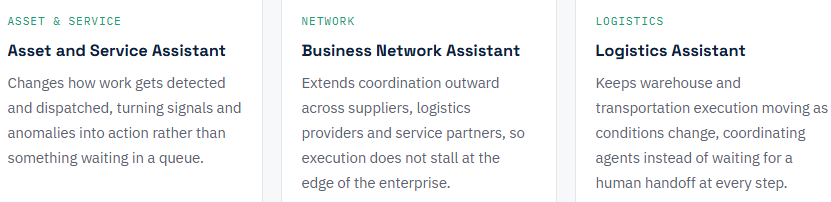
Availability is phasing across 2026 as each assistant reaches general release.
The Joule Agents Doing the Work

Assistants set direction. Agents do the task level work underneath them. SAP has introduced three new Joule Agents purpose built for supply chain and procurement operations, embedded directly into SAP Cloud ERP and SAP Business Network.
1. Production Planning and Operations Agent: Automates the prerequisite checks before a production order is released, validating material, capacity and scheduling, and can recommend a workaround or release the order the moment it is ready.
2. Change Record Management Agent: Reasons over problem reports and change requests, recommends next steps, and can initiate the change itself, improving traceability and governance along the way.
3. Supplier Onboarding Agent: Reasons over supplier data, issues invitations, validates submissions and handles exceptions, letting procurement teams scale onboarding instead of processing it manually.
Individually, each agent removes a specific bottleneck. Together, they compress the time between a signal appearing and a decision being acted on, which is the entire point of moving from orchestration to autonomy.
The Platform Underneath It All
None of this works as a collection of separate tools bolted together, which is why SAP paired the announcement with the SAP Business AI Platform, a new foundation that unifies SAP Business Technology Platform, SAP Business Data Cloud and SAP Business AI into one governed environment. Joule Studio sits on top as the development layer, letting teams build with no code, pro code or open AI frameworks depending on what a given process needs.
At scale, the suite is expected to deploy more than fifty domain specific Joule Assistants, orchestrating a pool of over two hundred specialized agents across finance, supply chain, procurement, human capital management and customer experience. SAP has also confirmed that Claude, Anthropic's model family, is among the foundation models powering Joule agents across HR, procurement and supply chain, grounded in SAP's own business context and operating inside governed, defined processes rather than acting freely.
Why the Data Foundation Decides Everything
SAP's own supply chain leadership has been direct about the limiting factor here: it is not model quality; it is data quality. An AI system built on stale or inaccurate data does not fail quietly, it produces the wrong answer with more confidence and more speed. Companies whose ERP and supply chain systems are already stable, accurate and reliable are the ones positioned to get real value from embedded AI. Everyone else is automating a mess faster.
This is exactly where a clean, well governed S/4HANA foundation earns its keep. Consistent master data, a disciplined Clean Core approach, and finance processes such as Material Ledger, Actual Costing and Group Reporting that reflect true cost and margin all become the substrate that autonomous assistants reason over. Get that foundation right, and orchestration has something solid to act on. Skip it, and every new agent just inherits the same blind spots the business already had.

Measuring Value, Not Just Cost
There is also a shift underway in how supply chain performance gets talked about in the boardroom. After a period where resilience was pursued almost regardless of price, leadership is once again asking hard questions about profitability, even as climate risk, cyberattacks and geopolitical fragmentation keep rising. The result is a move toward measuring supply chains on total value delivered, not unit cost or inventory turns alone.
That reframing matters for finance and controlling teams specifically, because it means supply chain contribution increasingly needs to be expressed in the language of growth, margin protection and market share, alongside working capital, service levels, risk exposure and sustainability outcomes, all in a single performance conversation.
What This Means for SAP Customers Today
Autonomous supply chain management will roll out in phases through 2026 and beyond, which gives most organizations a real window to prepare rather than a deadline to panic about. A few practical steps make that preparation count.
a. Audit the data foundation first: Master data quality, Clean Core discipline and integration health determine whether an assistant helps or hurts.
b. Pilot one assistant in a bounded process: Supplier onboarding or production order release are natural starting points with measurable outcomes.
c. Bring finance and controlling in early: Agent driven decisions touch cost centers, margins and working capital, so governance cannot be an afterthought.
d. Plan adoption around SAP's release cadence: Aligning internal readiness to each assistant's general availability date avoids both delay and premature rollout.
The Linear Supply Chain Has Run Out of Road
For decades, supply chains were designed for a fairly predictable world. Demand followed patterns, suppliers were stable, and lead times were something you could plan around rather than fight against. That world is gone. Geopolitical shifts, tariff changes, extreme weather, labor disruption and swings in customer demand now arrive constantly, and a decision made in sourcing can ripple through manufacturing and logistics within hours rather than weeks.
The response many organizations have taken is orchestration: connecting design, planning, procurement, manufacturing, logistics and service into one coordinated operating model, rather than optimizing each function in isolation. It sounds obvious. In practice, it is one of the harder shifts a supply chain organization can make, because it touches systems, data, governance and org structure all at once.
Nearly half of supply chain executives recognize the benefits of full orchestration, yet most have not taken decisive action to get there.
Based on IDC research surveying 300 C level executives globally, published alongside SAP's supply chain orchestration announcements.
What SAP Supply Chain Orchestration Actually Is
SAP introduced SAP Supply Chain Orchestration at SAP Connect in October 2025 as the foundation for this shift. It is an AI centered solution built to detect potential disruptions early, evaluate the risk against a company's own supply chain configuration, and trigger coordinated action across planning, logistics, procurement and manufacturing rather than leaving each team to react on its own.
What sets it apart is where it sits. The solution runs on SAP Business Technology Platform and pulls together data from SAP Business Network and SAP Business Data Cloud, giving a single view across every tier of the supply chain rather than just the tier a company transacts with directly. That multiple tier visibility is what turns a scattered set of risk signals into a prioritized, actionable response.
General availability is phasing through the first half of 2026, with the full AI capable version following in Q2 2026 after a beta period.