

Clean Core in SAP Cloud ERP: The Foundation for Sustainable Transformation
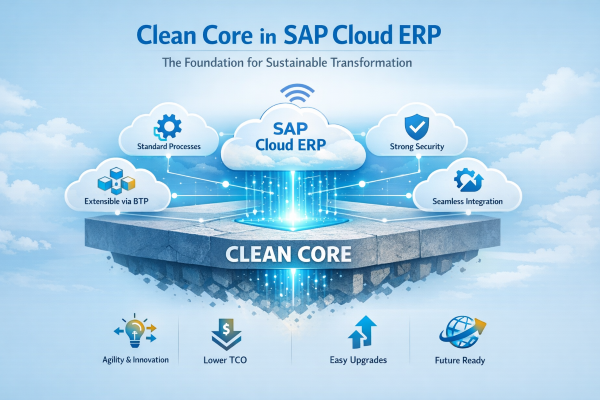
Enterprises adopting SAP S/4HANA Cloud (now positioned as SAP Cloud ERP) or transforming through RISE with SAP are pursuing the same strategic outcome: accelerate innovation without losing governance, compliance, or operational control.
That balance does not happen by accident. It requires architectural discipline.
The SAP clean core methodology provides that discipline by keeping the ERP system aligned with SAP standard and shifting differentiation to approved extensibility layers. Instead of embedding business logic deep within the digital core, organizations rely on configuration, APIs, and external services. The result is a system that upgrades cleanly, integrates predictably, and evolves at the pace of the business.
When customization is controlled and governed, updates install without disruption, integrations remain stable, and technical debt is minimized. The ERP becomes a reliable platform for change rather than a barrier to it.
What is an SAP Clean Core?
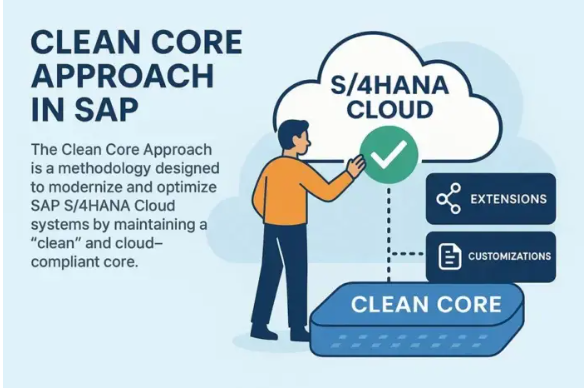
A clean core describes an SAP Cloud ERP or on-premises SAP S/4HANA environment that remains as close as possible to standard SAP functionality. Enhancements are built externally using approved frameworks such as SAP Business Technology Platform (SAP BTP), rather than modifying core ERP code.
This model ensures:
Upgrade-safe releases delivered on SAP’s innovation cycle
Transparent and governed extension development
Controlled key-user extensibility
Long-term compatibility with SAP innovations
Clear separation between core processes and custom innovation
Industry groups like ASUG consistently position clean core as foundational to agile ERP transformation. Standardization does not eliminate differentiation. It protects it. Business-specific innovation happens at the edge, while the core remains stable and secure.
At SAP Sapphire Orlando, SAP leadership reinforced that clean core is no longer optional. It is a baseline expectation for modern cloud ERP strategies.
The Cost of Heavy Customization
Many long-running SAP environments (especially those that began in classic SAP ERP or early on-premises deployments) carry a deep layer of historical custom ABAP development. At the time, those modifications solved real business gaps. They enabled competitive differentiation, supported complex industry requirements, and often compensated for functional limitations that existed years ago.
But custom code accumulates quietly.
One enhancement leads to another. A user exit becomes a modification. A report evolves into a tightly coupled process dependency. Over time, what was once targeted and justified turns into an interwoven architecture where standard and custom logic are difficult to separate. The result is not innovation but a structural drag.
The consequences are measurable.
Upgrade cycles slow down because regression testing becomes a project in its own right. Every enhancement must be validated against every other enhancement. Technical teams hesitate before applying support packages or feature packs because the blast radius is unclear. What should be a technical routine becomes a business risk event.
Total cost of ownership increases in less visible ways. Legacy custom code ages alongside the platform. Original developers leave. Documentation becomes incomplete. Debugging time expands. What was once straightforward ABAP turns into archaeological work.
Agility suffers even more. Integrating modern analytics, AI services, or cloud-native capabilities becomes complicated when core business logic is embedded directly inside the ERP. Introducing tools such as SAP S/4HANA innovations, embedded analytics, or AI-driven automation requires navigating layers of custom dependencies that were never designed for modular integration.
Performance can degrade as well. Excessive custom processing inside core transactions increases database load, elongates batch jobs, and reduces system responsiveness. What users experience as “ERP slowness” is often architectural accumulation.
Security and compliance exposure also rise. Custom code may not follow evolving best practices for authorization checks, data handling, or logging. Each bespoke enhancement becomes another component that must be reviewed during audits. In highly regulated environments, this introduces additional governance overhead and risk.
When an SAP landscape drifts far from standard, even minor upgrades demand disproportionate effort. A technical update becomes a validation marathon. Innovation cycles slow. The ERP starts resisting it. That tension directly contradicts the purpose of moving toward cloud-based transformation.
The clean core approach changes this direction.
Instead of embedding business logic directly into the digital core, extensions are externalized. Custom processes move to side-by-side architectures. Integration becomes API-driven rather than modification-based. Enhancements follow SAP-approved extensibility frameworks rather than altering standard objects.
In environments like SAP S/4HANA Cloud or private cloud deployments, this discipline is not just recommended but completely foundational. Extensions leverage released APIs, in-app extensibility, and event-driven mechanisms. The ERP core remains stable, predictable, and upgrade-ready.
Structurally, the system regains clarity. The boundary between standard and custom becomes visible again. Upgrades become technical events instead of transformation programs. Innovation (analytics, automation, AI) can connect through governed interfaces rather than invasive code changes.
Clean core does not eliminate differentiation. It relocates it.
Once that architectural separation is restored, agility returns.
Extensibility with SAP Business Technology Platform
The first approach to extending an SAP ERP system is through ABAP extensibility on-stack. Adopting a clean core strategy does not eliminate the ability to extend the system with ABAP. On the contrary, SAP still supports controlled, governed extensions using ABAP, enabling organizations to build what are often referred to as “tightly coupled extensions.”
These extensions run within the ERP environment and directly interact with standard processes while maintaining alignment with SAP’s upgrade and support framework. They are typically used for enhancements that require deep integration with core transactions, custom business logic, or industry-specific requirements that cannot be fulfilled through configuration alone.
For organizations planning an ABAP-based extension strategy, SAP provides comprehensive guidance. A detailed reference document titled Extend SAP S/4HANA in the cloud and on premise with ABAP-based extensions was updated in May 2023 and offers structured direction for extension project managers, key users, and ABAP developers. It covers architecture principles, recommended practices, and governance considerations. In addition, recent publications on ABAP Cloud and SAP S/4HANA extensibility updates provide further insight into how extension models have evolved to support cloud readiness and controlled customization.
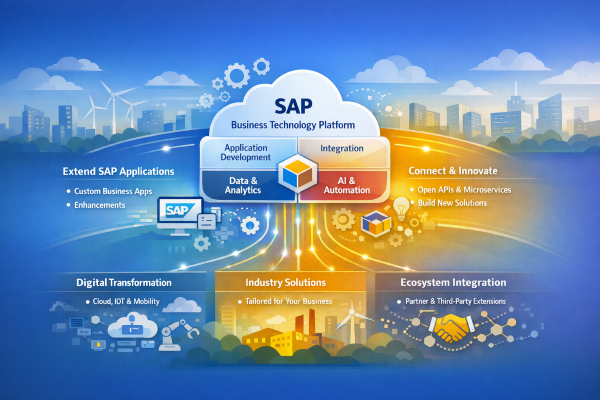
Beyond on-stack extensibility, organizations can leverage the broader SAP Business Technology Platform (SAP BTP) to build modern, loosely coupled extensions.
SAP BTP provides a comprehensive development foundation for professional developers through tools and frameworks such as:
(1) SAP Cloud Application Programming Model (CAP) - A high-level, model-driven development framework used to build and extend cloud-native business applications. It simplifies service creation, data modeling, and integration with SAP and non-SAP systems while promoting scalable and maintainable architectures.
(2) SAPUI5 - A JavaScript-based UI framework for building responsive and enterprise-grade web applications tailored to SAP environments. It enables developers to create custom user interfaces that integrate seamlessly with backend services.
(3) Fiori Elements - A UI development toolkit that delivers pre-built enterprise design patterns for SAP Fiori applications. It reduces development effort by generating standardized user interfaces based on metadata and annotations.
(4) SAP HANA Cloud - A cloud-native database platform that enables real-time data processing and analytics using in-memory computing. It supports advanced data management scenarios for extension applications requiring high-performance analytics and transactional capabilities.
(5) Business Application Studio - The preferred integrated development environment for SAP-centric development. It provides ready-to-use development spaces with built-in tools, templates, and runtime environments for building SAP Fiori applications, CAP-based services, and SAP S/4HANA extensions efficiently.
In addition to professional development tools, SAP offers a powerful low-code and automation portfolio under SAP Build, enabling business and technical teams to participate in extension development.
The SAP Build portfolio includes:
SAP Build Apps - A low-code platform for building web and native mobile applications. It includes embedded backend capabilities and allows business users and citizen developers to create enterprise-ready applications without writing code, while maintaining connectivity to SAP and external systems.
SAP Build Process Automation - A tool designed to automate business processes and repetitive tasks using visual design capabilities. It supports drag-and-drop workflow modeling, robotic process automation (RPA) bots, prebuilt content packages, and connectors for both SAP and non-SAP systems. This enables cross-functional teams to rapidly implement automation while maintaining governance and control.
SAP Build Work Zone - A digital workplace platform that centralizes access to applications, processes, information, and collaboration tools into a single entry point. It enhances user productivity by providing a unified interface accessible from any device, simplifying system navigation and improving adoption.
Another key component of the extensibility landscape is the SAP BTP ABAP Environment, previously known as “Steampunk.” This service provides ABAP as a cloud-native platform running on SAP BTP. It allows customers and partners to leverage existing ABAP skills to build new cloud-based solutions or modernize legacy on-premise ABAP assets.
Applications built in the SAP BTP ABAP Environment run side-by-side with the extended SAP S/4HANA system. This side-by-side model ensures separation from the core while maintaining integration through standardized APIs and service-based communication. As a result, organizations can innovate independently from their core ERP system while preserving upgrade stability and minimizing risk.
Clean Core Within RISE with SAP
RISE with SAP provides a bundled path to SAP Cloud ERP, combining software, infrastructure, and transformation services.
Clean core methodology is fundamental to a successful RISE journey. It is an architectural approach within RISE with SAP that keeps the central ERP system as close to the SAP standard as possible by minimizing custom code and direct modifications.
Instead of embedding heavy customization inside the core, organizations extend functionality using upgrade-safe tools and standardized integrations. This improves system stability, upgrade readiness, and innovation speed.
The Five Key Principles
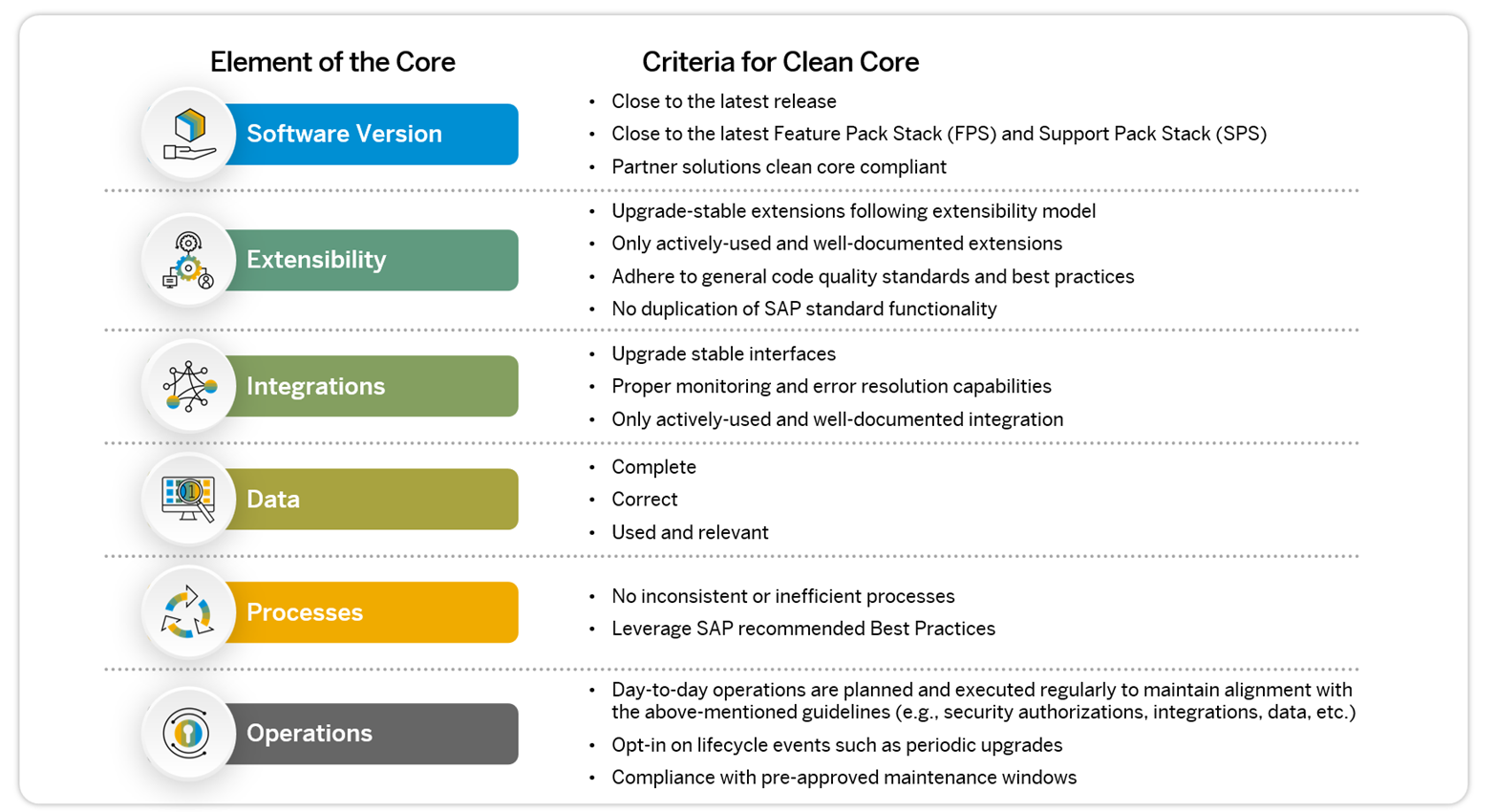
Business Processes: Adopt a fit-to-standard approach by leveraging SAP Best Practices before building custom solutions.
Extensibility: Build custom functionality outside the core using platforms like SAP Business Technology Platform (BTP) and upgrade-safe tools such as ABAP Cloud.
Data: Maintain strong data governance and quality control to reduce complexity and improve compliance.
Integrations: Use standardized APIs (e.g., OData, REST) for system connectivity instead of complex point-to-point custom integrations.
Operations: Apply continuous governance and monitoring with tools like SAP Cloud ALM to maintain architectural discipline over time.
Conclusion
Clean core is a strategic foundation for sustainable innovation in modern SAP environments. It goes beyond technical best practice — it establishes enterprise-wide discipline around stability, predictability, controlled innovation, and long-term cost efficiency.
By aligning core ERP functionality with standard SAP capabilities and extending through platforms such as SAP Business Technology Platform (SAP BTP) and orchestration solutions, organizations ensure that innovation is delivered through governed and upgrade-safe mechanisms rather than ad hoc customization.
Enterprises that adopt a clean core approach benefit from reduced maintenance effort, lower operational costs, faster adoption of SAP innovations, and simplified upgrades. The architecture strengthens system reliability while improving adaptability to changing business demands.
Most importantly, clean core prepares organizations for emerging capabilities in AI, advanced analytics, and third-party integration, without compromising the integrity of the core system. Architectural clarity becomes the enabler of long-term transformation and sustained business value.
ERPfixers stands as your trusted beacon of reliable SAP expertise, founded to bridge the gap for those seeking skilled, immediate, and high-quality SAP solutions.
Our team is composed of top-tier thought leaders and seasoned consultants specializing across all major SAP modules, with particular strength in Financials and Controlling (FI/CO) in S/4HANA. Many of our experts are also published authors on key SAP topics.
We provide tailored, actionable guidance to help you optimize processes, streamline implementations, and transform complexity into competitive advantage.
Don’t let SAP challenges slow your transformation. Partner with ERPfixers to make your SAP landscape more agile, efficient, and future-ready.
📧info@ERPfixers.com
📱+1 (207) 573-0486 x 800
▶️Follow us on LinkedIn